Fish leather
Today, fish skin is being revealed as a hidden treasure, unveiling exceptional qualities: captivating textures, unique patterns, and above all, a singular beauty born of scales and shimmering reflections. Transformed with exacting standards and sensitivity, it becomes a medium of art, where the unexpected finds both form and meaning.


A heritage that inspires me
Used for centuries in Asia and the Nordic countries, fish skin has also been highly prized in Europe, particularly in the form of shagreen - a leather made from ray or shark skin, popular since the 18th century and revived during the Art Deco period.
Precious objects, cases, trays, furniture and accessories were covered in this uniquely grained, dense and pearly material, a symbol of luxury and refinement.
This heritage inspires me: it shows that this material, far from the discarded image it is given today, has always seduced people with its originality and richness.

From the market...
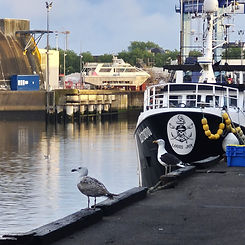
My artistic practice is based on transforming fish skins, sourced from fishing vessels landing their catch at the port of Lorient.
I collect the skins from my fishmonger at the Halles de Merville market in Lorient, 9 km from my studio. These skins would otherwise have had a very different fate.

to workshop
The river work
The river work, to clean the skin of all traces of flesh, remove the skin and prepare it for the following stages
The vegetable tanning bath
Made with tannins extracted from wood shavings, often collected from a cabinetmaker or purchased from an eco-responsible supplier. Each species and each desired finish requires a suitable tannin.
Colour
The plant extracts used during the tanning process can naturally colour the skin. Depending on the desired effect, the tannins contains can then be oxidised through contact with metal, revealing new shades.
Drying and currying
To soften and finish the material. On average, a month and a half passes between collecting the skins and this final stage, depending on the type of skin.


At this stage, each skin reveals its uniqueness
The pattern of the fibres, the nuances of colour, the textures. Time, a fundamental element in my work, allows us to discover them. It's a slow, patient process that I'm proud of. It allows you to observe, touch and feel. It is the condition for wonder.


Then it's time to draw and compose
I draw my inspiration from the skins themselves, from what they evoke, to create works that combine abstraction and narrative. Here again, time is an ally: it allows the material to find its shape and the image to be born.
All stages are carried out by me, with consistency and responsibility in mind
All the stages are carried out by me, with consistency and responsibility in mind. I use as many locally sourced or reused materials as possible. This approach has also led me to rethink the support of my works, which is now made from a high-density material produced from recycled polyurethane offcuts. Its environmental and health performance is documented through an FDES (French Environmental and Health Product Declaration) and a assessment under the AgBB scheme.

For me, creating means taking care. Of matter. Of life. Of time.
My work is a sensitive response to the issues. An invitation to slow down, to look differently, and to honour what nature offers us. It's also a human adventure, shaped by the gestures of the seafarers who come before mine, by encounters, and by the skills and knowledge of all those who, around me, make this approach possible.